
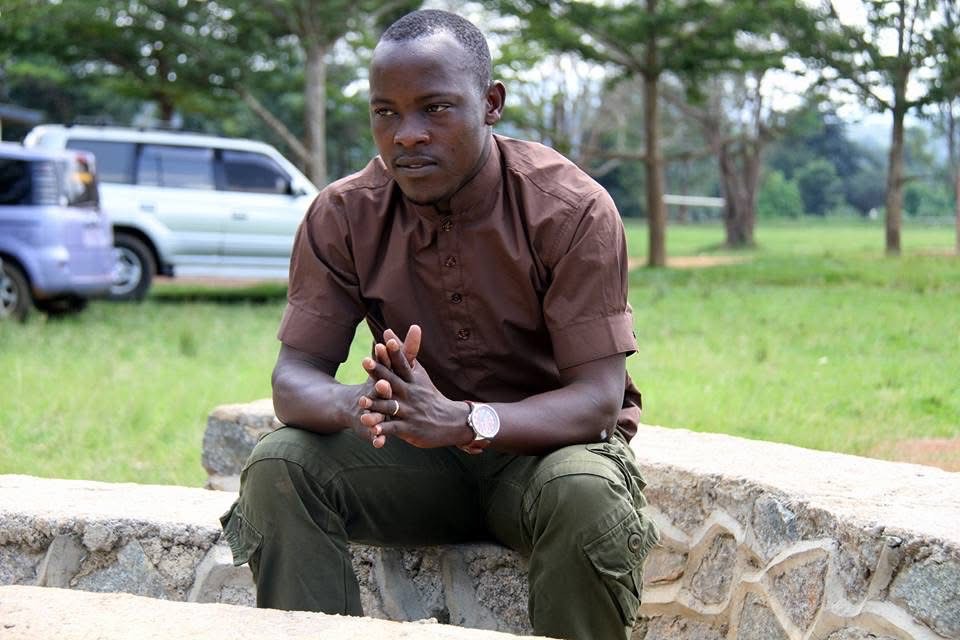
Thierry Banga Lole, a journalist and cameraman working in Bunia was fatally attacked by unknown individuals on 28 December 2025. In response to this killing, organizations defending journalists’ rights have called for an independent, credible, and transparent investigation, citing this incident as evidence of the multiple challenges journalists continue to face, ranging from ordinary crime to state violence. The police, meanwhile, claim that the killing was the result of an attack by bandits that went wrong.
By Ukweli Coalition Media Hub
On the night of December 28–29, 2025, in the heart of Bunia, the capital of Ituri Province in northeastern Democratic Republic of the Congo, Radio-Télévision Nationale Congolaise (RTNC) journalist and cameraman Thierry Banga Lole was fatally attacked at his home, located in the Hoho neighborhood of Mbunya commune.
This killing happened at a time of heightened security, tensions and militarization of the provincial administration. No valuables were taken by the assailants. Only bloodstains and machete wounds on the victim’s head. From early on, the authorities framed the incident as the result of a robbery, as Bunia is a city regularly plagued by nighttime attacks and armed violence.
According to the official version provided by the Congolese National Police (PNC), Lole was attacked by bandits armed with bladed weapons. “Two of the four suspects in a targeted operation have already been arrested,” announced the PNC’s urban commander in Bunia, Senior Commissioner Gérard Abeli Mwangu, on January 1, 2026. Two weeks later, on January 13, 2026, all four alleged assassins were officially presented to the military governor of Ituri by the provincial commissioner of the Congolese National Police, Commissioner Ngo Isengelo.
“A few weeks ago, the city was shaken by the assassination of a journalist. According to the police, the investigation into this crime led to the arrest of four suspects initially, which then led to the arrest of a dozen more people. Among those presented, several are soldiers,” Senior Commissioner Gérard Abeli Mwangu later told the military governor.
However, organizations that defend journalists’ rights do not believe this narrative. For Journalists in Danger (JED) and the National Union of the Press of Congo (UNPC), this death is a symptom of the pressure that media in the east of the country faces, where, in their words, “coverage of security, military, and political issues remains particularly sensitive.” The two organizations organized a protest march in Bunia, which ended in front of the governor’s office. The governor said that investigations were already underway, and the results would be made public.
Born on October 7, 1989, in Bibwa, Thierry Banga Lole began his career as a cameraman in the early 2010s before being recruited in 2018 as a staff member at RTNC, the national television station. He was a father of five children, and was known for his discretion, having been called upon on several occasions to cover official activities and community events, and to make occasional trips to high-risk areas.
A journalist whose name had appeared in a military court file
In early 2025, Lole’s name appeared in a case handled by the military justice system. He was suspected of having ties to the Convention for the Popular Revolution (CRP) militia, created in March 2025 by Thomas Lubanga, a close family member. He was then placed under judicial supervision and required to sign in regularly. His assassination occurred while he was banned from leaving Bunia, a restriction that had lasted more than eight months. The investigation lasted several months but yielded no results. According to one of his colleagues, the case was closed in November. Thierry was also suspended from his duties at RTNC, but at the time of his death, he had been reinstated, as Benx Katonji, provincial director of RTNC in Ituri, confirmed when contacted by Ukweli.
According to multiple local sources, Thierry was also among the founders of the WhatsApp group “La Voix de l’Ituri” (The Voice of Ituri), a popular forum where journalists, civil society members, and political actors often commented critically on provincial governance, security management, and actions by the authorities during the state of siege.The WhatsApp group shared the same name as an online media outlet, lavoixdelituri.net, that Lole was known to have co-founded.
“It was a group he was forced to shut down after appearing before the military prosecutor,” a colleague confirmed. However, to date, nothing suggests a direct link between his journalism work and his assassination. Still, several local actors believe he had attracted unwanted attention, given how visible the WhatsApp forum was in a politically sensitive area. “Since that episode, he kept saying he no longer felt safe,” a close friend recalled.
“The military does not share information. In a context like ours, under a state of siege, it is always difficult to assess the seriousness of the danger facing a colleague or a loved one. Military courts play a central role in maintaining public order, and this type of proceeding is sometimes far from trivial,”another colleague commented.Ukweli unsuccessfully tried to reach Colonel Magistrate Kumbu Ngoma Jean Baptiste, Attorney General of the Superior Military Prosecutor’s Office in Ituri, who local sources said was in charge of the late journalist’s case.
Ituri has been a state of siege for several years, with a military governor from the FARDC and an administration largely controlled by the security forces. Officially, this measure is intended to curb violence by armed groups. “In reality, targeted killings, armed attacks, and settling of scores remain frequent, including in urban areas,” says Dieudonné Lossa, coordinator of Ituri Civil Society. Journalists are not spared. In this area, media representatives say that attacks against journalists are on the rise.
The Provincial Civil Society Coordination Group points out that several recent murders remain unsolved, hinting at a state of chronic impunity. “The population is tired of impunity,” warns Dieudonné Lossa.
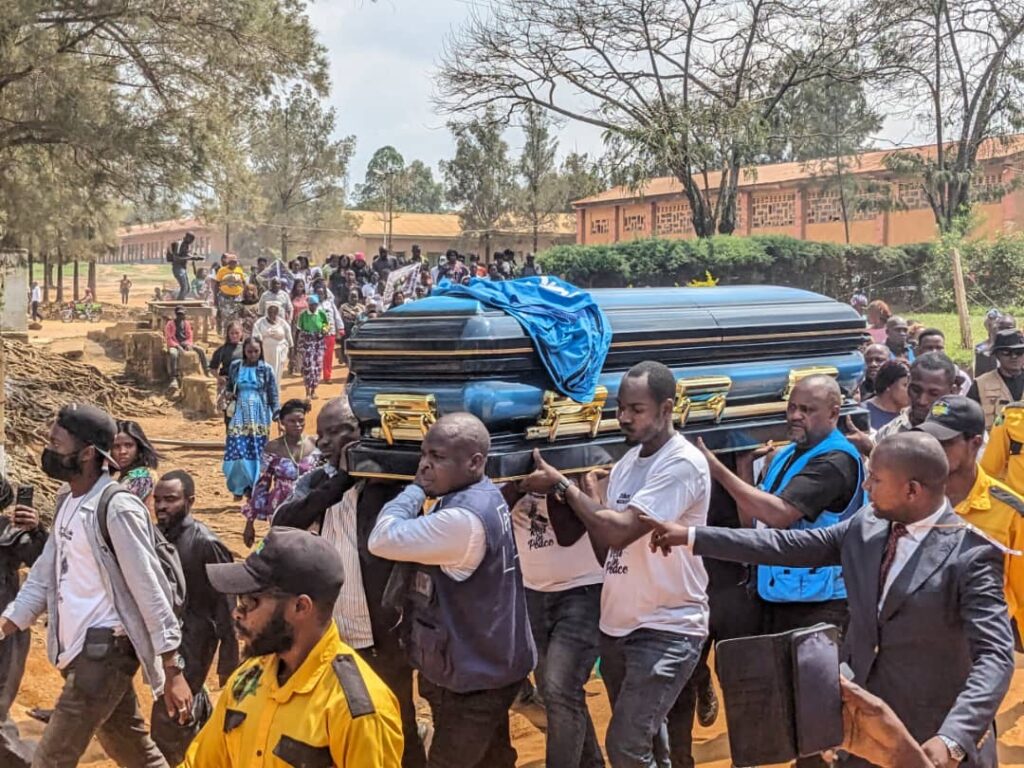
At Thierry’s funeral on January 5, Sylvie Musoke, a member of the National Union of the Press of Congo (UNPC)’s Ituri Section executive committee, categorically stated, “Journalism is not a crime. No journalist should die for doing their job.” With her voice breaking, Musoke went on to say, “You can kill the man, but you cannot kill the truth. The camera may fall, but the light will not”. Also speaking at the funeral, Freddy Upara, JED focal point member, reminded those present that killing a journalist is an attempt to silence the truth.
UNPC, JED, and other journalist and media support organizations in the region are calling for an independent, credible, and transparent investigation into the killing.
Read also: Between the AK47 and the camera, I made my choice.