
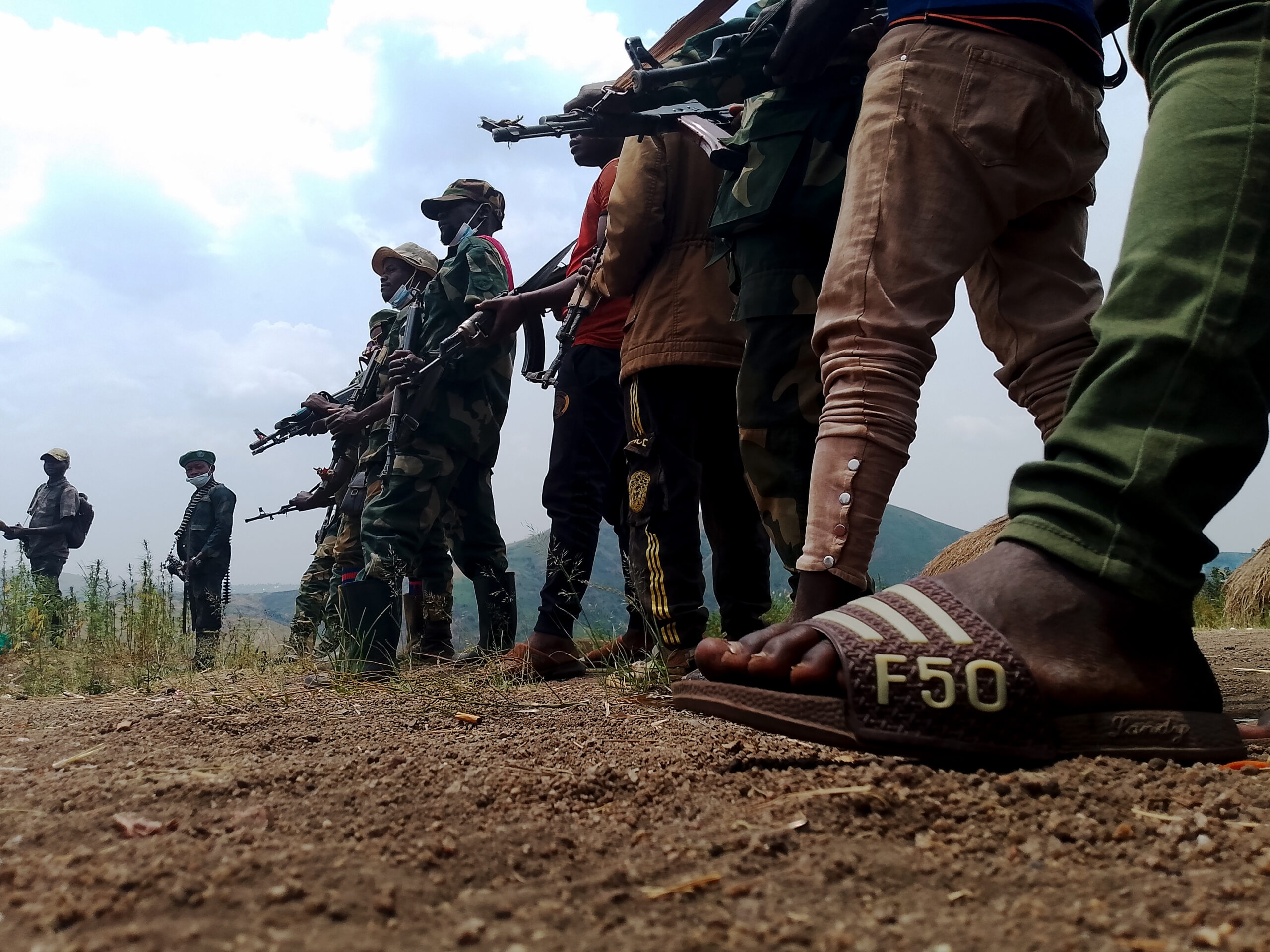
Franck* (a pseudonym for security reasons) is an investigative journalist based in eastern Democratic Republic of Congo, a region plagued by several armed groups, including the M23 movement, which currently controls a large part of the territory. Franck’s continued practice of journalism is fraught with peril. Having lost loved ones during the various armed conflicts, he is now forced to practice “anonymous journalism” for his own safety, not to mention the daily pressure he faces to join the armed groups. A testimony.
By Armel-Gilbert Bukeyeneza
Founding Director of Ukweli Coalition Media Hub
It was a black day in his career. A day when everything almost changed, when he was tempted to throw down his camera and take up weapons. Franck* (his real name has been changed) was still a young reporter, 26 years old, with three years of experience, when his newsroom sent him to cover an attack in 2021 that had just occurred in his village in eastern DRC. Franck was born and raised in war, one might say. He had seen and endured everything, “too much”, considering his age. But this time, he had no idea what awaited him. While his village counted its dead, and he, nervous but focused, captured images of the terrible attack, of children dying and bodies still bleeding from the blasts, a friend pats on his shoulder. “Can’t you see you’re photographing your own cousin?” The pointed warning falls on deaf ears. Franck remains impassive. He snaps shot after shot with the cool composure of a war correspondent. His friend is forced to wrest the camera from him. “The body lying in front of you is your own cousin!” Words as sinister as they are unexpected, bringing Franck to the brink of fainting while his friend suggests he steps back – in vain. He is forced to pull Franck by the arm and find him a chair to rest. The day before, just under twenty hours earlier, Franck and his cousin had spent the evening with their family, having drinks and dinner together.
“Can you imagine covering a bomb attack where almost half of the twenty victims (eight wounded and one dead) are members of your family? For the first time, I doubted the ability of journalism to bring any change to my community. I felt so powerless that I was ready to take up arms and fight,” he confesses today. Against all odds, Franck ended up becoming an investigative journalist, unfortunately forced by circumstances to work anonymously, and is now a journalist for a community media outlet. When meeting him during a training session, he seems more determined than ever. Calmly, he first offers a slight smile whenever asked to comment on the news in his country. A smile as mysterious as it is revealing. “It’s not easy, man,” is his go-to opening line, whenever he wants to deliver a harsh truth about the practice of journalism in his region. “We have several journalists who have joined the various rebel movements. It’s the rebel leaders themselves who come looking for us, mainly to help them with PR to legitimize their taking up arms. And it’s sometimes hard to refuse. Some of these leaders are old school friends. Most of the groups they lead claim to be defending our communities and ethnic groups, and some journalists sometimes fall into these traps. Furthermore, these rebel leaders may think you know too much about them. In such cases, turning your back on them can prove very risky”.
And what about Franck himself ? “Oh, man! I’ve been approached several times. And it doesn’t stop.” Franck adds another, well-known fact: “These groups have access to the country’s resources. They control mining operations and are involved in all sorts of illegal trafficking. They’re rich. When you know the financial state of the media and journalists in the DRC, you’ll understand why their offers can sometimes be hard to refuse. Personally, I spent three years earning less than ten dollars a month in a newsroom. In the DRC, a journalist is easy to buy. You understand why they’re being used as propaganda tools to spread fake news, which, in turn, fuels the armed conflicts on the ground. Our precarious situation makes us easy to manipulate. If it’s not armed groups, it’s politicians. Or both. They’re sometimes even linked.”
A childhood dream
The fact that Franck is still a journalist, and even an investigative one, is perhaps no coincidence. Journalism is a childhood dream he’s fighting to live: “I’ve always had great admiration for journalists. I saw how they fought to make our voices heard. I was still a kid, but their determination to stand up for the community when almost everything was against us, in a context of war, left a deep impression on me.” Franck officially entered journalism in 2018, defying his parents’ wishes for him to become an engineer, a less “controversial” and less risky profession than journalism. A profession that, obviously, pays better than journalism in the DRC. “I have a lot of respect for engineers, but it’s not for me. I’ve always wanted to be a voice for my community. I started speaking on the radio when I was 15, on entertainment programs.”
Admiration or idealization? Franck would eventually get to the bottom of that question when, in 2021, he found himself in a position of responsibility at a government-affiliated media organization. “Most of the journalists who were working there, were in this position because political actors or authorities had pulled some strings. Journalism isn’t just about accepting guidance from your editor; it’s also about accepting criticism. There was none of that. Just contempt from the young reporters who were still learning how to handle a camera.” Yet, he laments today, the organization had the resources. “Something most newsrooms lack. A real waste in my eyes because the organization had all the potential to make a difference.”
Seven years after officially entering journalism, Franck seems to have lost none of his commitment, much less his admiration for journalism, despite the calls and pressure to join the armed groups operating in his region. Franck is one of the journalists behind the investigation, published last July, into the illegal cocoa trade between the DRC and Uganda, involving armed groups, the armies of both countries, businessmen, and state agents. This investigation earned Ukweli Coalition Media Hub a nomination from Reporters Without Borders for its 2025 Press Freedom Awards. Just a few weeks after publication, the investigation appears to have prompted a series of measures taken by the authorities, either to ensure the protection of farmers or to prohibit taxes deemed illegal on cocoa sales, as reported by local media outlets.
With a calmer voice and a nuanced yet still concise tone, Franck shares the survival strategy for journalists today working in conflict zones like eastern DRC: “We have an extremely sensitive task: to report in a context of war. Impartiality and neutrality must be our watchwords, our compass. They are our shield in terms of security and legal protection.” Words that, when applied to the reality on the ground, remain difficult to put into practice, he acknowledges: “It’s complicated to demand neutrality from a journalist who can’t even pay their rent, even if neutrality is for their own safety. We need support, a certain financial stability. It’s an important pillar for working independently and guaranteeing quality reporting. And it’s certain that this support won’t come from political actors, much less from armed groups.”
Entitled “Eastern DRC: War crimes committed against the press…”, the annual report of the organization “Journalist in Danger” (JED), published last November, revisits the damning record of attacks on media and journalists over the past twenty years in Eastern Democratic Republic of Congo: twenty journalists killed out of a total of 2670 attacks, which combines the assassinations of journalists, those who have disappeared, have been detained, and media that have been destroyed. Alerting the public to the current phenomenon of “forced recruitment of journalists under the guise of ideological training, in training camps where they learn to handle weapons,” primarily in the South and North Kivu provinces controlled by the M23 Movement, the organization lists a whole series of predators of press freedom spanning the last two decades: “While under President Joseph Kabila, the main perpetrators of attacks against journalists and the media were essentially limited to the security services, Congolese intelligence, and national or provincial authorities, under the new head of state, activists from various political parties (both the current government and the opposition) are also among the executioners of press freedom. Furthermore, militias and armed groups in the eastern provinces of the country, under rebel control, have been added to the list of main perpetrators.”