
In eastern DRC, the scandalous complicity between militias, army elements and financial institutions behind the illegal gold traffic
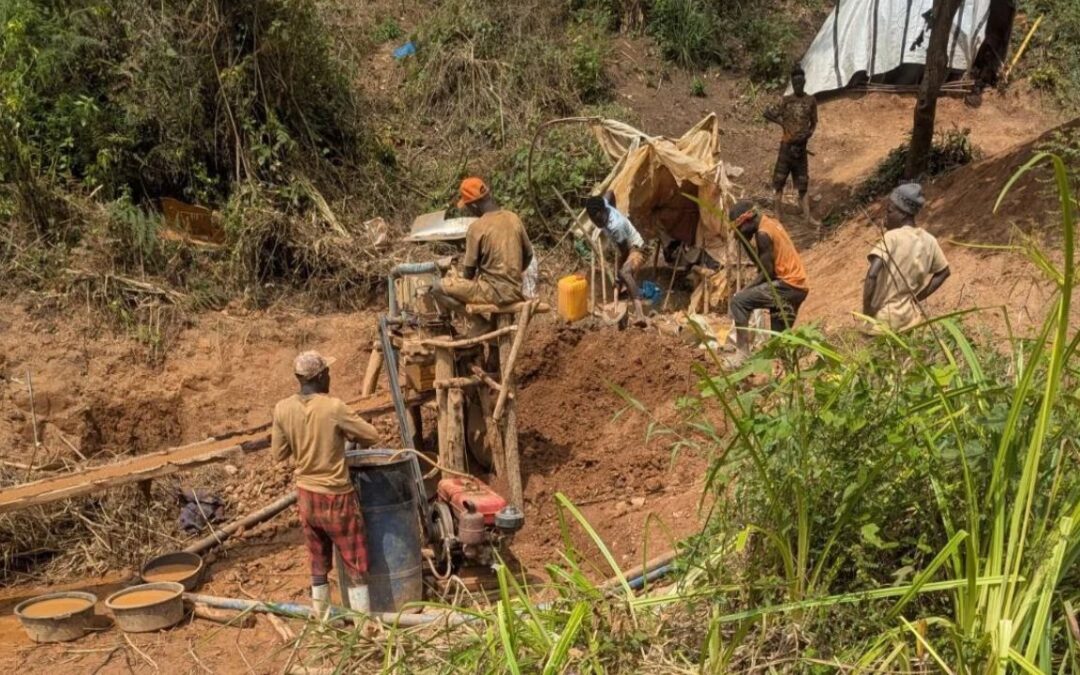
July 2026. Day is barely breaking over the Tshalaka valley, in the Bahema-Baguru chiefdom, Djugu territory, in Ituri province in the east of the Democratic Republic of Congo. Artisanal gold miners emerge one after another from their makeshift stalls set up right in the middle of the village. A few minutes later, picks on their shoulders and boots firmly on, they are already on their way to the gold mine.
Among them is Richard* (not his real name). He has been an artisanal gold miner for many years. A regular of the gold sector, he owns his own mining plot and employs about twenty diggers. The mine is located in an area under the control of the ethnic militia Cooperative for the Development of Congo, CODECO/URDPC, led by the self-proclaimed general Basa Zukpa Guerson. Already named in several United Nations reports as the perpetrator of serious human rights abuses, this self-defense armed group of the Lendu and Ngiti communities controls most of Djugu territory, a paradise teeming with hundreds of artisanal mining plots.
“For a few days now, production has dropped. Here, gold has become scarce. The machines yield less and less and expenses are starting to exceed profits…,” murmurs Richard*, looking slightly worried but with his gaze firmly fixed on his worksite from the little hill of Zaza. It is nonetheless a normal process, he explains: “When a mining quarry has been exploited for a long period, it runs out.”
And the man, Richard, has already made his decision to change territory. He wants to settle further south, in the neighboring territory of Irumu, on another gold site located in an area controlled by another militia, the Patriotic Front for Ituri / Chini ya Kilima (FPIC), led by another self-proclaimed general named Tondabo Kakani, known by the nickname Herode, but recently killed during his incursion into an Ebola treatment center in Nyakunde.
The move is often more than a simple relocation of an artisanal operation. In eastern DRC, changing mines means changing authority, rules, taxes, and sometimes armed interlocutors.
A goldmine of revenue for armed groups
Ukweli reporters followed Richard* to his mining site, located roughly forty kilometers south of the city of Bunia, the capital of Ituri province. To reach the area, one must pass through a succession of roadblocks. Some are held by soldiers of the national army, the FARDC, others by members of the mono-ethnic armed group the Patriotic Front for Ituri / Chini ya Kilima (FPIC).
In total, twelve roadblocks, in addition to the road tolls legally set up and managed by the Congolese authorities. According to drivers who use this stretch of road, the payments demanded at each checkpoint generally range between three and five thousand Congolese francs (between one and two euros), i.e., 30,000 to 50,000 Congolese francs per trip (10 to 20 euros) for a one-way journey, an amount our sources consider very high for a population living below the poverty line.
A few hundred meters from Richard*’s mine, two final checkpoints mark the entrance to the mining zone. One is held by the FARDC (the official armed forces of the DRC), and the other by the militiamen. The two posts are less than a kilometer apart, and it is hard to imagine that one is unaware of the other’s existence. To pass both, one must pay, in gold or in cash.
In this gold-bearing region of Ituri, gold never travels alone. Around every gram extracted, there are official taxes, “by government tax collectors but sometimes without any receipt,” notes a mine operator at the site. Informal levies by armed groups and fees owed to landowners also apply to every activity. Following the path of an artisanal miner also means following the many actors who live off this illicit economy.
According to our interlocutors, these demands are not limited to this one site. They are also applied for access to several other mining sites located in the various territories of Ituri province that are under the influence of armed groups, notably in Djugu, Irumu and Mambasa.
According to several miners interviewed, the levies by armed groups far exceed the taxes and fees officially owed to the State. These payments are often made directly in gold or converted into cash, according to arrangements made on the ground. These sums, according to local actors, constitute the main source of financing of these armed movements, which generally have no other income-generating activities. A claim that the leader of the CODECO militia tried to qualify not long ago: “The minerals are in our villages, we have the right to exploit them,” said Bassa Zukpa Gerson, in an interview given to Journal Africa published on 10 March 2025.
The report of the United Nations Secretary-General of 30 November 2023 describes the abuses committed by CODECO: “In the territories of Djugu and Mahagi, CODECO fighters continued to attack civilians and Congolese armed forces, albeit with less intensity than in previous periods. Between 21 September and 24 November 2023, CODECO fighters allegedly killed 42 civilians, including at least 8 women and 11 children, and wounded 19 others, including at least 3 women and 1 child.”
These abuses have multiplied over the past three years, with armed attacks directly targeting displacement camps, as the media and humanitarian analyses have extensively documented. 999,000 internally displaced persons had been identified in Ituri Province as of 31 May 2026, according to the United Nations Office for Humanitarian Affairs, while hostilities between government forces and members of the Convention for the Revolution of the People of Thomas Lubanga (already convicted by the International Criminal Court) continue in Djugu territory in Ituri.
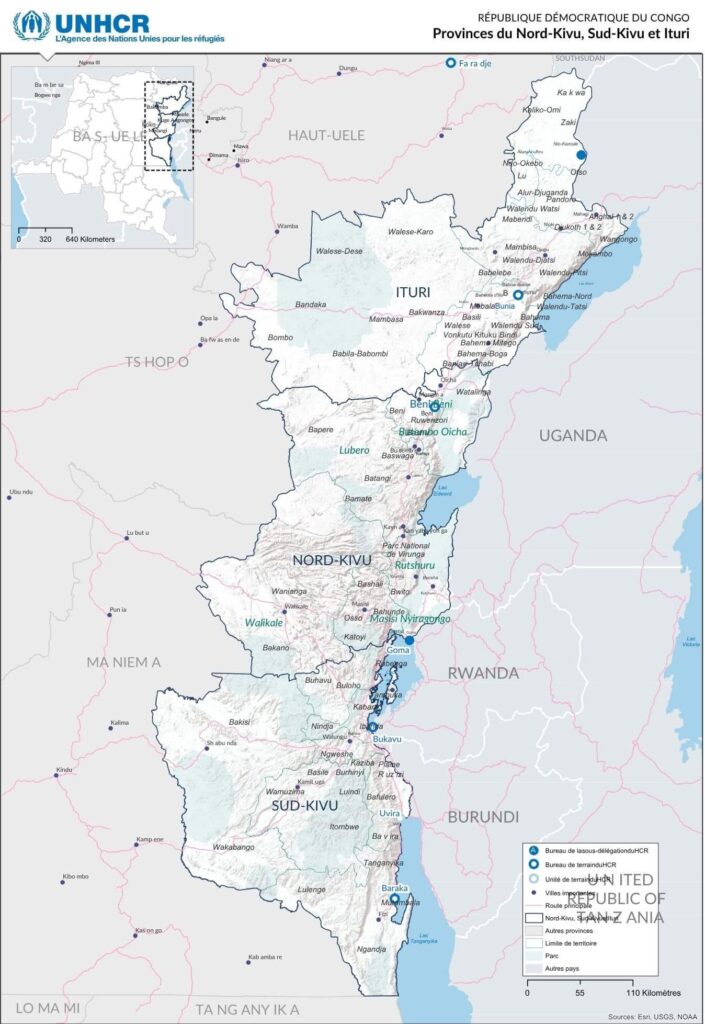
To the south, several hundred kilometers from Ituri, in Lubero territory in North Kivu province, the mechanisms observed around gold mining sites are similar. There too, access to deposits, their exploitation and the circulation of minerals are subject to a multitude of levies imposed by the many armed groups present in the mining area.
Rebels mining directly, soldiers abandoning their mission
Indeed, in certain localities of North Kivu and Ituri, the various armed groups do not content themselves with taxing the activity of miners. Some exploit mining sites directly, with their own men, their prisoners or their hostages, illegally, sometimes with the full complicity of financial institutions and with the State turning a blind eye.
In the Okapi Wildlife Reserve of Epulu, in the heart of Mambasa territory, for example, soldiers of the national army have reportedly abandoned their posts to engage in gold mining in several rivers, according to multiple testimonies. “Some are in the integral conservation zone [of the protected area]. They are armed and poorly dressed. They say they are doing it on behalf of their superiors, but we do not yet know which ones. And several clashes with us rangers were narrowly avoided,” says, under anonymity, a ranger of the Congolese Institute for Nature Conservation deployed in the area. Control of an integral conservation zone is in principle the exclusive remit of eco-guards. However, over the past two years, FARDC soldiers and members of armed groups have been reported there, allegedly to fight one another. As a reminder, the provinces of Ituri and North Kivu have been under military administration since May 2021 with the mission of restoring State authority in the face of the proliferation of armed groups, which draw their strength, among other things, from control of mining operations.
A financial institution at the heart of the trafficking
Among the key players in the illicit mineral trade in North Kivu, Ukweli reporters met the (COPEMEPA), “Coopérative Minière pour l’Émergence Paysanne”. On paper, nothing alarming. Just a local economic relay intended to support the artisanal miners who become its members. In reality, several testimonies and documents consulted show that the Cooperative served as an institutional front to organize credit, permits, and marketing channels for the ore in the Butambisi–Butembo region, for the benefit of more than one militia. This is notably the case of the Islamic State in Central Africa, which formed mainly around the former Allied Democratic Forces (ADF), of Ugandan origin, one of the deadliest militias in the DRC with thousands of civilians killed, now accused of war crimes and crimes against humanity by reports, notably from the United Nations.
Cooperative officials centralized sales and provided administrative cover that allowed gold to pass to structured buyers while concealing its illicit origin, which made it possible to secure financial flows for the benefit of the armed group. The manager of COPEMEPA, Freddy Bakobatama, currently in detention and whose case is still with the military justice according to our sources, is accused of having facilitated purchases of gold, food and non-food items for the benefit of the Islamic State in the DRC.
According to cooperative members interviewed by Ukweli, whose testimonies match the content of the official reports consulted, COPEMEPA collected taxes and fees from miners who, in return, received authorization to mine and market gold in this entity under the control of the Islamic State in the DRC.
Butembo, the hub of laundering
The process is quite well known to locals. Illegal gold, extracted by armed groups, sometimes those accused of the worst atrocities against civilians, seems to have a well-laid and securely guarded path, through a whole chain of actors, into the formal circuit. Collaborations are forged between armed groups, artisanal mining operators and traders based notably in the city of Butembo, as well as in several trading centers in the surrounding towns such as Mangurejipa, Nziapanda, Cantine, etc.
In Manguredjipa, a locality about sixty kilometers west of Butembo, Trésor*, the proprietor of a local gold-buying counter, describes the system: “It regularly happens that members of armed groups come to sell material at our counters. Sometimes we recognize them by face since they are often in the community, but we do not ask our customers where the ore they bring us comes from, especially for security reasons. But often, people sell here locally when they only have small quantities. When the volume is larger, they go directly to Butembo, as we do ourselves (the local buyers, editor’s note).”
This testimony is corroborated by other sources, who confirm that one of the main weaknesses of the supply chain is the absence of systematic verification of the origin of the ore. “Gold extracted illegally by armed groups is introduced into formal trade circuits right from the small trading centers, blurring any possibility of telling the two apart,” explains yet another local source familiar with the trafficking.
Several other testimonies gathered during this investigation say that once in Butembo, sellers with large quantities of gold, whether miners, traders, civilians, members of the national army or of armed groups, turn to a small number of well-known economic operators whom we have decided to keep anonymous for security reasons. “The gold is then melted into ingots and integrated into export circuits without any possibility of tracing its origin,” reveals a trader.
Other armed groups bypass the local and national circuits entirely to collaborate with foreign exporters. A commander of one of these groups operating in North Kivu province describes the existence of direct relationships between several armed groups and buyers based in Kampala, in neighboring Uganda. Part of the gold thus leaves Congolese territory clandestinely in exchange for cash, logistical supplies or, in some cases, weapons and ammunition intended to supply the group, he confided to us anonymously. His militia is operational in Lubero territory alongside the FARDC and other allied militias that are members of the “Wazalendo” coalition.
According to him, the Congolese government, lacking the means to support its local allies, turns a blind eye and lets it happen: “We manage on our own to finance the movement, by mining gold or by charging certain taxes, without being bothered by the State or the FARDC. Besides, we have no problem with the FARDC on this point because they too control mining sites in Mangurejipa, near ours…,” he adds.
Recently, his movement was contacted, says the same source, by a potential partner, a minerals trafficker based in Kampala, Uganda, with whom transactions are being prepared, notably a potential exchange of gold for ammunition. As a reminder, Uganda, already cited by several international reports as a hub for illegal gold coming from eastern DRC, notably Ituri, the most recent of which was produced by United Nations experts, posted a historic record in 2025 for its exports of the yellow metal, which earned it nearly 6 billion dollars according to the Ugandan authorities’ own statements, placing gold at the top of Uganda’s export revenue sources, even though the country has no significant known deposits of the mineral compared with its neighbors.
Two weeks before the publication of this investigation (i.e. on 30 October), Ukweli contacted the government spokesperson and Minister of Communication, Mr. Patrick Muyaya, to respond to the statements of the leaders of the armed groups gathered within the “Wazalendo” coalition (allied to the FARDC, especially in the war in eastern DRC) who spoke in this investigation. Statements to the effect that “the Congolese authorities let them control and exploit (gold) mining plots in the provinces of North Kivu and Ituri as a form of reward/recognition.” Our question was whether one should say that the Congolese government is helping to sustain instability in the two provinces (Ituri and North Kivu) by deliberately leaving mining operations to armed groups, given that an armed group remains an armed group, whether or not allied to the government, and that these groups are even accused of serious human rights violations.
The minister referred Ukweli to his adviser, Mr. Prince Lukeka, who asked Ukweli to indicate the groups concerned, the identity or function of the people who spoke, “with respect for the protection of our sources,” he specified, as well as the date and place of their statements. He then asked for the mining plots concerned, their location and the references of the corresponding titles or exploitation areas, as well as the authority that would have granted these rights, at what level, by what act and on what date, promising us that the government would respond upon receipt of these elements.
Ukweli was able to provide him with the identities of the armed groups and mining plots concerned. However, we were not in a position to provide him with the identities of the people who spoke in this investigation or any other related detail, in the name of source protection, as the minister’s adviser himself acknowledges. We also let him know that the locations of the mining plots concerned (provided by Ukweli) can make it possible to identify the authorities with the mandate to manage these artisanal mining zones, if the government wishes to know who would have granted these armed groups the mining exploitation rights.
Our response was sent to the minister’s adviser on 3 November. Since then, he has not come back to us.
Ukweli also contacted Bruno Mandevu, FARDC Commander in Ituri province, to respond to the allegations that soldiers had abandoned their posts to engage in illegal gold mining, and that they were doing so on behalf of their superiors. Our question was whether the FARDC are now part of the problem regarding security stabilization and the restoration of State authority in Ituri province, which they are nevertheless supposed to restore.
The commander answered us. “The FARDC cannot be a problem, instead of being the solution,” he told us. He also suggested that we call the curator himself of the Okapi Wildlife Reserve (RFO), which is cited in this investigation, “the only respondent,” according to the commander, “instead of an RFO (Okapi Wildlife Reserve) agent informing us anonymously,” he said.
The commander then put us in contact with Mr. Balemba Emmanuel, Chief Conservator and Deputy Site Manager of the Okapi Wildlife Reserve. Here is his response: “To my knowledge, there is no group of FARDC soldiers that has abandoned its post for illegal mining in the Reserve. On the other hand, ICCN/RFO (Congolese Institute for Nature Conservation/RFO, editor’s note) operates jointly with the FARDC through the CorPPN (Corps for the Protection of National Parks and Related Reserves).”
Bruno Mandevu also asked us to “call the Comd BDE (Brigade Commander, editor’s note) Mambasa to get the real information.” “Or organize a field visit in Mambasa to get the real situation, instead of phone calls from people who may distort the truth,” he added. Ukweli was unable to organize an additional field visit after six months of investigation and fieldwork, nor to contact the Brigade Commander, considering that his reaction and that of the Chief Conservator of the Okapi Wildlife Reserve were sufficient.
Ukweli tried to contact the management of COPEMEPA to respond to the investigation’s findings that the Cooperative allegedly helped armed groups, including the ADF, which pledged allegiance to the Islamic State, obtain mining extraction permits, and thus be able to insert them legally into the economic circuit in order to finance their war activities, and thereby keep the region in instability. It did not respond.
This investigation was conducted with the support of Africa Uncensored, the Committee to Protect Journalists (CPJ), and Media in Cooperation and Transition (MiCT) for risk analysis and prevention.