
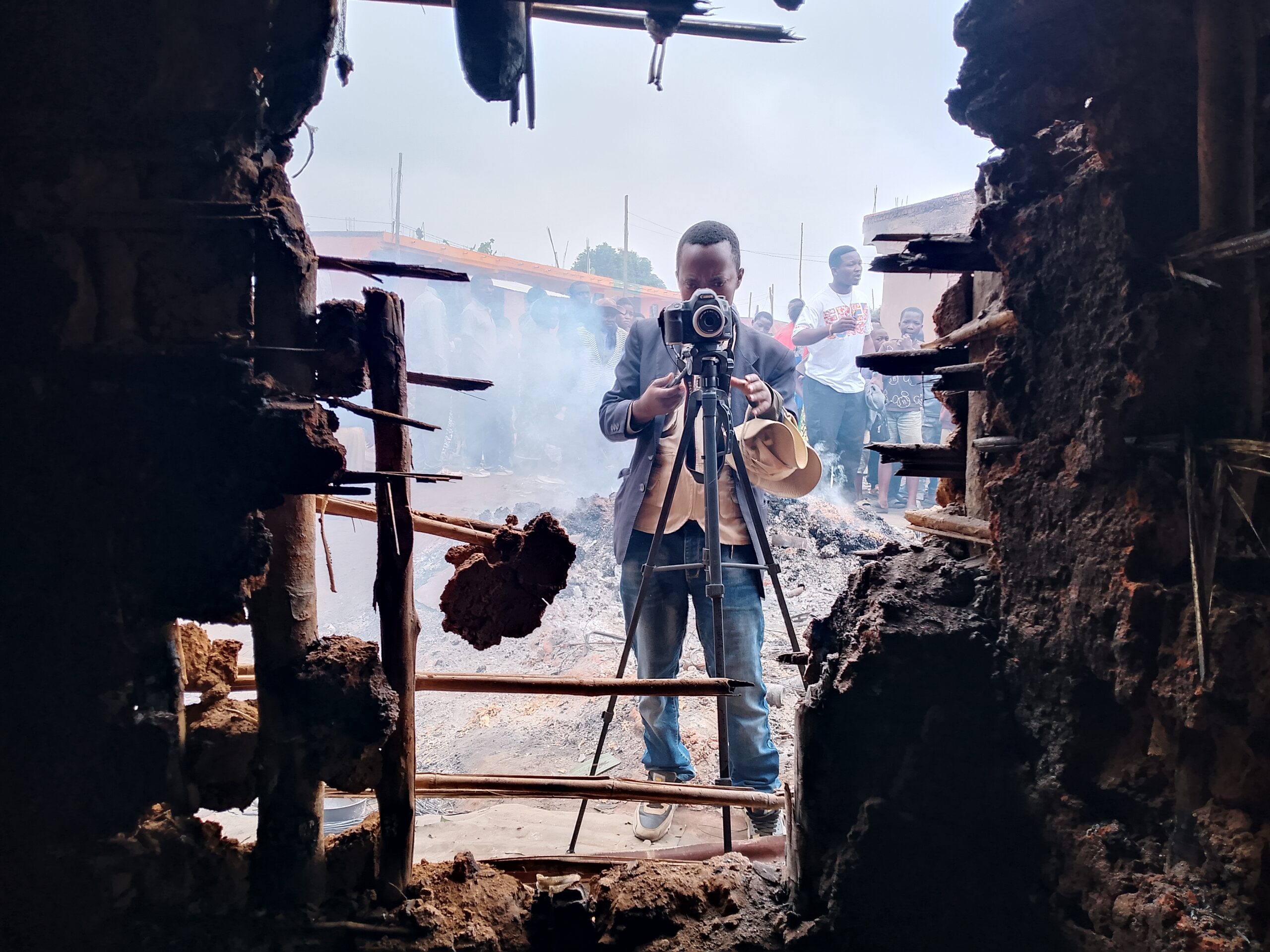
Since the capture of Goma in January 2025 by the AFC (Alliance Fleuve Congo)/M23, and the subsequent capture of Bukavu, journalists in eastern DRC have been working under untenable conditions. Broadcasting bans, muzzled sources, direct threats, self-censorship, suspicion of collaboration with the rebels, and a rift with journalists’ organizations based in Kinshasa. Whilst the world celebrates World Press Freedom Day on 3 May, we return to the field, between Goma and Bukavu, to find a press that bends but does not break, crushed between the hammer of the rebel movement and the anvil of the government.
By Ukweli Coalition Media Hub in collaboration with ZAM Magazine
It is 8.30 am in a neighborhood of Goma. For the first time since the war, the editorial team is meeting at this late hour. The early-morning meetings, which used to be scheduled for 6.30 am, are now in the past. On the street leading to the newsroom, there is little traffic. The silence is broken only by the occasional hesitant passer-by. On the kerb, faint traces of recent clashes. At the entrance to the radio station two bullet holes still mark the glass panel above the staircase. Visible traces of violence that is still fresh in mind.
Inside, the atmosphere has changed. Where once morning meetings were animated by debates and analyses of current affairs, the tone is now measured. The journalists exchange few words. Anxiety is evident on their faces. The reunion, after several days of separation forced by the war, takes place without any real outpouring of emotion. During the meeting, editorial priorities are quickly redefined. “Let’s avoid playing with fire,” warns the editor-in-chief, calling for caution. Sensitive topics, particularly military and political ones, are set aside in favour of local news. But the uncertainty is not limited to editorial content. It is financial too. “We don’t know when our donors will get back in touch, but we must carry on working,” he adds, in a grave tone.
A few months ago, all media outlets in Goma and Bukavu were afraid to resume their work. When the fighting died down, a few weeks after Goma was taken, the local radio station came back on air, but only to broadcast music. “With the power and internet cut off, residents were left in a sort of black hole. We decided to provide a minimal service on the radio with music that might offer them some comfort during what they were going through,” says a broadcast technician at a leading radio station in North Kivu province.
Then the journalists gradually returned, following the tentative resumption of commercial and social activities in the major cities under occupation. But the newsrooms they find no longer resemble those they left behind. Some have chosen to fall in line, whilst others struggle, sometimes even at great personal risk, to remain objective. The national radio station broadcasting from Bukavu and another commercial radio station were the first to relaunch news programmes, but with an editorial line entirely geared towards promoting the AFC/M23, which controls the area. “Our mission is to provide media support for the new authorities,” says a reporter from this public broadcaster without hesitation.
“Pulling out a camera is just as dangerous as pulling out a gun”
The reality is more complex, the journalists contacted agree. “The AFC/M23 has laid down clear rules, including a ban on broadcasting news from Kinshasa so as not to relay what they consider to be regime propaganda. They have banned the broadcasting of humanitarian alerts from the United Nations Office for the Coordination of Humanitarian Affairs (OCHA), so as not to give Kinshasa any pretext for opening a humanitarian corridor,” says a former editor-in-chief, recalling that before the war, “Goma was a rapidly expanding media hub”. He recalls, regretfully: “We were like watchdogs.”
In Bukavu as in Goma the absence of official AFC/M23 spokespeople capable of answering journalists’ questions further complicates the situation. The movement has few, if any, identified local spokespeople, local journalists report. Communication is one-way. “When they need to communicate with us, they invite us and tell us what we must do and what we must not do,” says one of them, adding: “Some journalists maintain discreet links with colleagues who have become the movement’s press officers. It is through this informal channel that they sometimes receive invitations to cover official events, such as a mayor’s visit or a speech by the governor under AFC/M23. But this proximity is a double-edged sword, as the local population suspects these journalists of picking sides.”
Censorship also operates through constant physical surveillance. “Putting a voice recorder or a camera out in the street is now just as dangerous as someone pulling out a gun,” compares yet another journalist, who still vividly recalls the scene of a junior AFC/M23 officer stopping a colleague in the middle of the street: “I’ve been told you wanted to do a report here. That sort of thing is forbidden. You must leave before I call the authorities,” he had ordered, his face stern.
Another telling incident involves RTNK (Radiotélévision Ngoma de Bukavu) and an AFC/M23 spokesperson. It is 27 February 2025, the day of the movement’s first major rally at Independence Square — a gathering that would later be marred by two explosions leaving at least eleven dead — when cameramen from the movement ask to go up onto the roof of the RTNK building to film the podium from different angles. One of the managers refused, citing security concerns. The cameramen reported the incident to their superiors. An AFC/M23 spokesperson arrived at the premises himself, accompanied by a large number of officers. “Let’s put a stop to this nonsense once and for all!” exclaimed one of the officers. The manager had no choice but to apologize.
According to NGO Reporters Without Borders, which published an investigation last March into the M23’s detention of two journalists in shipping containers, “more than half of the attacks (murders, assaults, arrests, detentions, enforced disappearances, threats, and media outlets being shut down, looted or ransacked) targeting journalists in the country between January 2024 and January 2025 took place in eastern DRC (the provinces of North and South Kivu and in Ituri)”. That amounts to 42 out of 78 attacks, wrote the researchers in the report, without, however, placing all the blame on M23, which is not the only rebel movement in eastern DRC.
Contacted on several occasions, the M23 declined to comment.
A blend of ‘tactics’ for survival
Pressure, intimidation, summonses – in addition to imposed censorship, the majority of newsrooms still operating have adopted self-censorship, as a survival strategy. Politics, security, humanitarian issues… these topics are avoided in favour of social, cultural and environmental themes. “It’s also important, very important even. But at a certain level, the problem is that the environment can also become political. In short, everything is sensitive if you want to delve deeply into your subject,” explains another journalist from Bukavu. Some community radio stations, he laments, have even abandoned the participatory format that defined their identity. “No more live calls – too risky. We avoid security issues, political issues and topics that favour one side over the other. We leave those kinds of topics to official media outlets, which feel much safer than we do.”
Whilst others have chosen to wait for the storm to pass, documenting and archiving whatever they can, there are those who have adopted a more ‘subtle’ tactic: systematically avoiding the fundamental questions of journalism – the ‘who does what?’ – so as not to have to name those who control the area. Sometimes they will describe what has happened, without writing down who is responsible. “This trick spares us the burden of fundamental questions, the answers to which enable us to gather and write the news. Answering ‘who is doing what’ might force us to mention the new occupiers, and possibly end up defending them,” reveals a reporter for a community radio station in Goma. He adds: “Reporting can now be seen as a crime. The press in Goma is in a state of hibernation. Here, the sound of the truth hurts more than bullet wounds.”
The price to pay is often heavy for those who try to swim against the tide, remain independent, and defy censorship. Amisi Musaada, a journalist for the online media outlet déboutrdc.net and a socially conscious musician, knows what that may look like. In July 2025, he was abducted, held captive for several days and tortured before being released, due to his articles deemed too critical of the AFC/M23 war. Honneur-David Safari, head of the media outlet La Prunelle RDC, was followed by unknown individuals and then abducted in late December 2025. He was found some days later, alive but in poor condition. Shortly before, he had not hesitated to give a platform to those who criticized the ‘forced marches in support of the AFC/M23 movement’.
Radio Maendeleo, for its part, has been summoned several times to the Directorate of Intelligence Services (DSR, the equivalent of the National Intelligence Agency under the Congolese government), to account for the content of its programmes and the comments made by its guests. In November 2025, the mayor of Bagira under AFC/M23 directly threatened the presenter of the programme Hodi Mitaani for giving a platform to residents criticizing his administration. “We have been ‘invited’ four times to the DSR and once to the police. There’s nothing we can do; we just have to find a way to do our work in a war zone,” says a journalist from Radio Maendeleo in Bukavu.
Mistrust between Kinshasa and Eastern DRC
This is perhaps one of the major professional challenges arising from this war for journalists in Eastern DRC: a climate of mistrust that seems to be growing ever deeper with the authorities, including journalists’ organizations, almost all of which are based in Kinshasa. Media officials operating in areas under AFC/M23 control claim that ties have been severed, particularly after the president of the National Union of the Congolese Press (UNPC) in South Kivu “was forced under threat”, journalists from the region say, to collaborate with the movement. “Logically, Kinshasa has cut off contact,” explains a member of the organization in South Kivu, who also highlights the difficulty national bodies face in conducting investigations in areas controlled by the M23.
For their part, several journalists from Eastern DRChave criticized what they perceive as an excessive closeness between certain organizations and the national authorities, to the detriment of balanced coverage of the situation. “Why don’t they talk about the threats and arrests we face when we go into areas controlled by Kinshasa?” asks a journalist based in Bukavu. She claims that some reporters are suspected of colluding with the rebels, “because of where they live”, she says. Several of them say they have been detained, questioned and then released, their only ‘crime’ being that they live in areas under the control of the AFC/M23. “We have no choice. It is the rebels who control the area. To oppose them is to risk one’s life. We do not want to become collateral victims,” the journalist adds.
When contacted by Ukweli, Kamanda Wa Kamanda, president of the National Union of the Press of Congo (UNPC), took a hard line towards his colleagues in Goma and Bukavu, which are under AFC/M23 control: “I have also worked in conflict zones, but I remained professional. Journalists must defend their freedom. Either you are a journalist, or you are not.”
Several organizations defending journalists have suspended their activities in the region. This is the case with the Partnership for Integrated Protection (PPI), whose operations have been on hold for over a year. A member of its team cites security concerns, but also financial ones, particularly following the suspension of certain international aid programmes, including those from USAID. “We must protect ourselves first. Without resources, it becomes difficult to monitor the situation, particularly in the east,” he explains.
We attempted to contact the Minister for Communication and Media, Patrick Muyaya, to ask him to respond to the concerns of journalists who fear being arrested once they leave areas under AFC/M23 control, but he did not respond to our requests.