
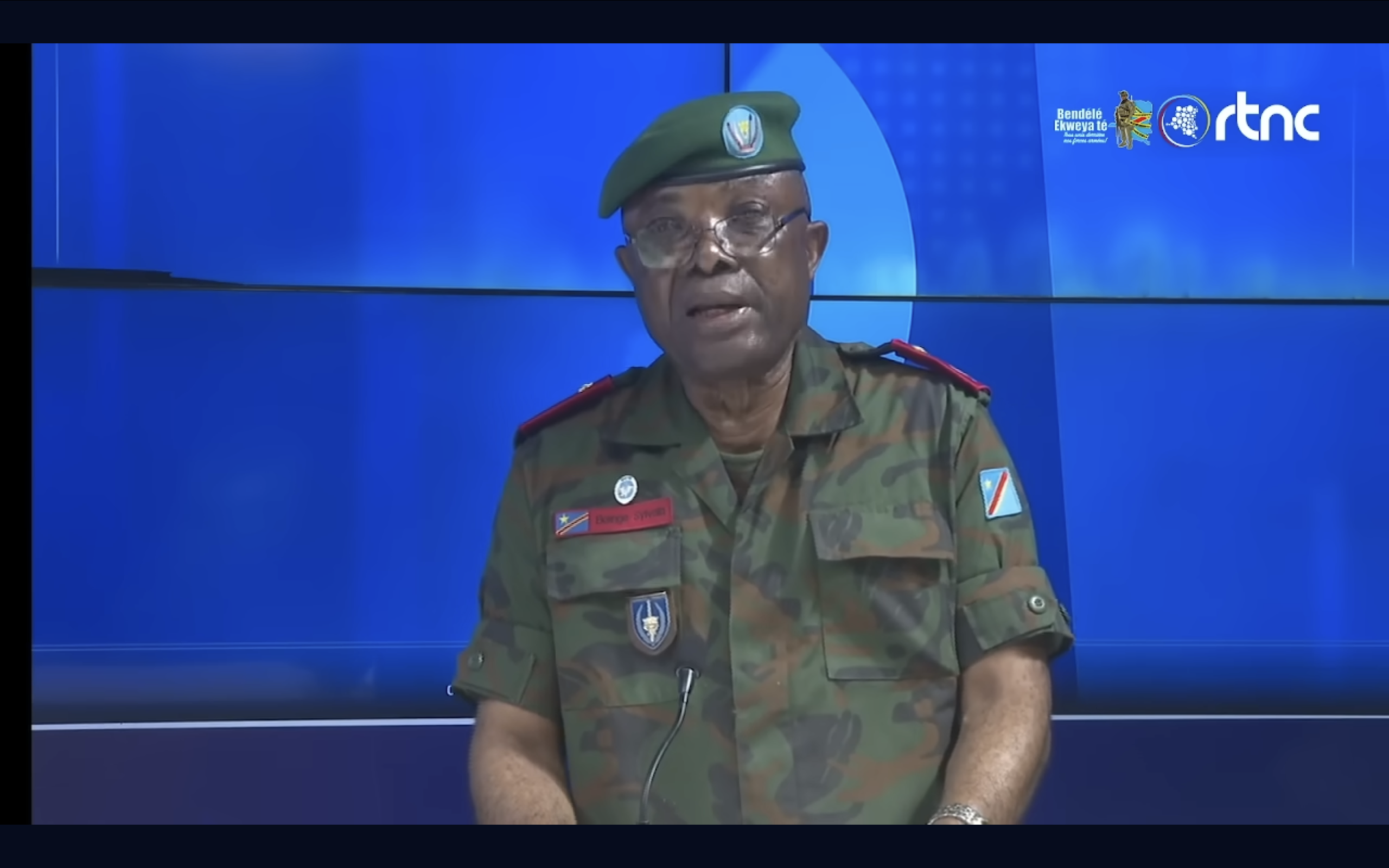
They are funded by taxpayers’ money and are referred to as “state media” or “government media.” In many African countries, they are often equipped with resources that very few private newsrooms can afford, only to end up serving as mouthpieces for political narratives. In the Democratic Republic of the Congo, the case of Major General Sylvain Ekenge—who used national television last December to attack one of the country’s communities before being suspended—has reignited the debate over the functioning of these media outlets “that have everything” but consistently fail to serve the people who, nonetheless, keep them afloat.
By Pascal Chirhalwirwa
Major General Sylvain Ekenge was suspended on December 29, 2025, from his duties as spokesperson for the Armed Forces of the DRC (FARDC). His superiors accused him of making remarks deemed discriminatory toward the Tutsi community during an appearance on a televised debate program on December 27 on Radio Télévision Nationale Congolaise (RTNC). “Remarks so serious as to echo those made against the same community on Radio Mille Collines in 1994 in Rwanda shortly before the genocide,” several observers noted.
Following the incident and the ensuing international outcry, it was time to determine who was responsible, particularly within the RTNC and the CSAC (the Higher Council for Audiovisual and Communication), the Congolese media regulatory body. Regarding the RTNC, sources close to the matter indicate that a number of internal measures have been taken, including the temporary suspension of journalist Oscar Mbal, who hosted the program that served as a platform for Sylvain Ekenge; the suspension of live broadcasts for programs covering sensitive topics such as security; and the requirement for interviews with guests to be recorded, reviewed, and approved by management prior to any broadcast. In contrast, the CSAC has remained silent. While its measures have previously targeted private media outlets, one might wonder why the CSAC has not publicly reacted to such a flagrant case, given that it typically announces its decisions when reprimanding a media outlet and/or a journalist.
When contacted, Serge Njibu, a rapporteur with the CSAC Bureau, defended the broadcaster, stating that “the measures taken by RTNC are the result of observations made by the CSAC following a meeting with the Director General of RTNC”. Mr. Njibu also adds that there are CSAC regulations outlining the conduct expected of the media during this period of crisis in the eastern part of the country, though he regrets that “the CSAC website has been attacked, causing it to be currently offline”, while reassuring that a digital portal is under construction and will be launched very soon to help disseminate the CSAC’s regulations.
RTNC, the perpetual true-false public service media outlet
This may be the central issue underlying the whole affair: should RTNC, which operates on Congolese taxpayers’ money, merely serve as a conduit for the political narrative? Or should it instead serve, with complete independence, the Congolese people by producing quality news (the RTNC is perhaps the only one with sufficient resources to do so), especially during this time of conflict when verified and credible information is invaluable? Of course, there is no easy answer, simply because the question, as clear as it may seem, is often left in the wrong hands. The RTNC remains under the direct authority of the Executive Branch of the government, which has its own political interests to protect. Yet, as the saying goes, “foolish is the sheep that confesses to the wolf”.
At the start of President Felix Antoine Tshisekedi’s first five-year term, Patrick Muyaya, the Minister of Information, Communication, and Media, announced with great fanfare a reform plan for his sector. These reforms were intended to enable the RTNC, long characterised by disproportionate national coverage, to transform itself into an effective media outlet that is representative of the entire national territory, competitive, meets international standards, and ultimately becomes a public service broadcaster. More specifically, this ambitious ministerial plan focuses on modernising and digitising RTNC studios in Kinshasa and across the provinces, implementing a new programming schedule to enhance visibility, particularly through various partnerships, building capacity through staff training, improving content quality, digitisation, combating misinformation, and the introduction of a broadcasting license fee to improve fundraising and ensure the institution’s financial autonomy.
In addition, the new legal framework governing information, communication, and the media in the DRC, notably Ordinance Law No. 23/009 of March 13, 2023 establishes the terms and conditions for the exercise of freedom of information and broadcasting by radio and television, the print media, or any other means of communication in the Democratic Republic of the Congo, and provides a legal basis for transforming the RTNC from a state-run media outlet into a public service broadcaster. In Chapter 2 on audiovisual media, Section 3 regarding public radio and television broadcasting services, Articles 64 through 66 provide clear guidelines on this subject. “Public audiovisual communication shall be objective, impartial, and pluralistic in the treatment and dissemination of information,” states Article 64, for example. The Ekenge case violates this provision in that the message conveyed was not supported by any tangible evidence. By stigmatising women in a community without presenting another side of the story, this message violates the principles of impartiality and pluralism.
As for Article 65, it emphasises the need to take “national characteristics and the needs of the provinces” into account in public communications. “In particular, through their editorial independence and balanced programming, they [public service radio and television] contribute to objective and impartial information, and to the cultural enrichment of the audience, notably by taking into account, as much as possible, Congolese productions, the country’s ethnocultural and sociopolitical diversity and the formation of public opinion at the national, provincial, and local levels.”
In light of this provision, the Ekenge case is a perfect illustration of the gap between the provisions of the ordinance-law and the reality on the ground. In the context of the crisis in eastern DRC, which is severely affecting cohesion among communities, using a media outlet funded by Congolese taxpayers to broadcast messages that stigmatise and pit communities against one another is simply unacceptable.
In the same context, Article 66 emphasises the public responsibility that public media must uphold: “Public media shall establish a benchmark programming schedule based on the public’s right to information, equal access, diversity of opinion, and the values of democracy, tolerance, openness, dialogue, and national cohesion.”
(Re)empowering citizens
A decree-law remains a decree-law. It originates from the Executive Branch. Perhaps it is time for the Congolese people to become the true masters of their own national media, at least through their representatives, namely Parliament. Even if the idea here is not to simply “copy and paste,” we see, for example, that in the quest to guarantee a certain editorial independence for public media, some African countries, especially those that are more advanced in terms of democracy, tend to involve their national assemblies, and even civil society and professional unions, in the process of appointing members to media regulatory bodies. In Ghana, for example, the National Media Commission (NMC) is established by the Constitution and is composed of members appointed by Parliament, trade unions, and other civil society entities. In turn, the NMC appoints the heads of state-owned media in order to protect them from direct government interference. In the DRC, the Director General of the RTNC is appointed by the President of the Republic upon the government’s recommendation.
Admittedly, laws and procedures are no magic wands, but at least they provide a solid foundation for real change. And it must be acknowledged that the RTNC’s commitment to independence did not begin with the current administration. From the RNC (Radio Nationale Congolaise) of the 1960s to today’s RTNC, via Mobutu’s OZRT (Office Zaïrois de Radio et Télévision), it is unfortunately clear that the media has merely changed names without ever meeting citizens’ aspirations for a true public service broadcaster, despite all its exclusive privileges: staff, financial resources, a larger audience thanks to provincial stations, easier access to official sources, and so on. Worse still, in some cases, it has been used against its true owners, the people, when political interests demanded it. Against the backdrop of the war in eastern DRC, a conflict also being waged in the media sphere, and in light of the plan by the presidential party, the UDPS (Union for Democracy and Social Progress) to amend the Constitution (there is already talk of a possible third term for the President of the Republic), the effort to transform the RTNC into a public service media outlet risks remaining a pipe dream for some time yet, especially if it remains in the hands of the Executive Branch.
Pascal Chirhalwirwa is a media expert and social entrepreneur who was awarded the title of Doctor Honoris Causa by the African Institute for Applied Multidisciplinary Research (IARPA – Abidjan)and the Centre de Valorisation Professionnelle de Tunis (CVPT)in November 2025. With more than twenty years of commitment to developing the media landscape, promoting the right of access to information, and supporting young people toward professionalisation and empowerment across various African countries, he is the founder and CEO of the consulting firm and incubator Colibri Multiservices (COMUS),as well as co-founder and editorial advisor of the media outlet Afia Amani Grands Lacs.